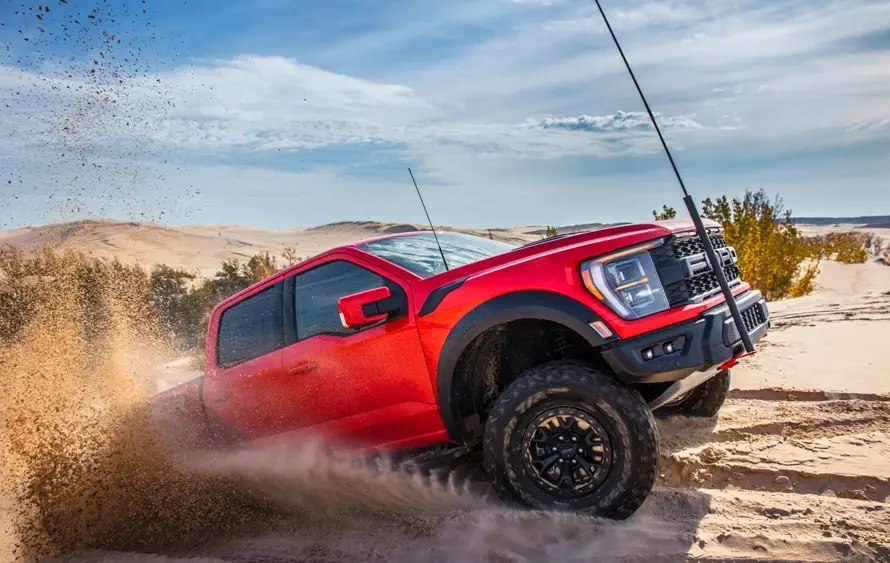
The hardest part of the 2026 Ford Ranger Raptor to explain to someone who has not driven one is what happens at 80 km/h on a broken road.
A standard pickup gets unsettled. The body starts to bounce. The steering goes vague. The driver eases back to 50. The Ranger Raptor stays composed. The shocks absorb impacts that would unsettle many conventional pickups, while the body remains planted and predictable. The driver often discovers that the truck remains far more composed than expected at speeds where many conventional pickups would begin to feel unsettled.
That is what makes the 2026 Ranger Raptor extraordinary. Not any single number on the spec sheet. The way every component is engineered to work at speeds and over surfaces that other 4x4s technically can do but will not stay composed through.

The Engineering Philosophy
The 2026 Ranger Raptor was developed by Ford Performance to solve a specific problem. Standard off-road trucks are built to crawl slowly through obstacles. Desert race trucks are built to fly across terrain at speed. Most production pickups sit in neither category cleanly. The Raptor was engineered as a factory-built high-speed off-road truck, not modified from a base, but extensively re-engineered from the Ranger platform for sustained speed across broken surfaces.
This is the core of the Raptor philosophy. Every major component has been chosen, sized, or reinforced to support sustained off-road performance at speed. The result is a truck that drives differently from any other production pickup, particularly above 60 km/h on bad surfaces.
The Fox Live Valve Suspension
Arguably the most significant component of the Ranger Raptor’s off-road package. The 2026 Ranger Raptor uses Fox Racing 2.5-inch Live Valve internal bypass shocks. Three things to understand about these:
1. Position-Sensitive Damping
Standard shocks have a single damping rate that applies throughout the wheel’s travel. Internal bypass shocks vary the damping at different points in the stroke. Compression is light early in the stroke (for ride comfort), firms up in mid-stroke (for control), and ramps up sharply at full compression (for bottom-out protection).
This means the suspension can absorb a 50 mm bump softly and a 200 mm hole aggressively, in the same stroke if needed.
2. Live Valve Real-Time Adjustment
Live Valve technology adjusts damping electronically in real-time based on sensors reading wheel speed, body acceleration, steering input, and throttle position. The system can stiffen the dampers during cornering, soften them on small bumps, firm them up on landings.
This is the technology that allows the Raptor to feel sporty on tarmac and absorbent on broken trails without changing settings manually.
3. Heat Capacity
Off-road suspension generates heat. Continuous use at high speeds across rough surfaces can overheat standard shocks, causing them to fade. The Fox 2.5-inch shocks have substantially more oil volume and surface area than standard truck shocks, which means they can absorb energy for much longer without performance degradation.
The larger Fox dampers are designed to resist heat build-up more effectively than conventional truck suspension systems, helping maintain consistent performance during extended off-road driving.
The Twin-Turbo 3.0L V6 EcoBoost
The 2026 Ranger Raptor’s engine produces 397 horsepower and 583 Nm of torque. The numbers are significant. Three things they enable:
1. Genuine highway cruising performance. The truck is not just adequate above 120 km/h; it is fast and stable
2. Low-range torque for technical sections. 583 Nm of torque produces strong low-speed pulling capacity for rock and mud sections
3. Altitude performance. Turbocharged engines generally retain performance at altitude more effectively than naturally aspirated alternatives. This makes the Ranger Raptor particularly well suited to regions such as Ladakh and Spiti, where reduced air density can affect engine performance.
The V6 also produces a specific exhaust note that has become part of the Raptor identity. The exhaust note remains a distinctive part of the Ranger Raptor experience, offering a more characterful sound than most conventional pickups.
The Reinforced Chassis
A standard Ranger chassis is engineered to handle work-truck loads at moderate speeds. The Raptor chassis adds:
1. Reinforced frame at critical stress points
2. Heavy-duty underbody armour protecting the engine, transmission, and fuel tank
3. Strengthened skid plates rated for impact
4. Upgraded mounting points for the Fox shocks
5. Revised suspension mounting points and chassis reinforcements designed to improve high-speed body control.
The chassis tolerances and tested capabilities exceed what most owners will ever push. This headroom is what makes the truck feel composed under conditions that would have a standard pickup at its limit.
The Drivetrain and Drive Modes
The Ranger Raptor includes seven drive modes optimised for specific terrain:
1. Normal — daily and highway driving
2. Sport — sharpened throttle, firmer dampers, tighter steering
3. Slippery — wet roads, light snow, loose surface stability
4. Mud/Ruts — soft surface drive program with traction tuned for mud
5. Sand — sand-specific tuning for traction and momentum management
6. Rock Crawl — low-speed technical with maximum traction and minimum throttle sensitivity
7. Baja — high-speed off-road desert mode, the signature Raptor setting
Most owners use Normal, Sport, and Baja most often. Mud/Ruts become important for Indian monsoon trail conditions. Rock Crawl for the technical sections of any high-altitude or coastal expedition.
The drive mode integration is meaningful. Each setting adjusts the engine response, transmission shift points, traction control intervention level, differential locking behaviour, dampers (Live Valve), and steering weight in coordinated ways.
What Indian Conditions Test
For Indian adventure use specifically, the Raptor’s engineering is tested by:
| Condition | Stress point | Raptor’s response |
| Long-distance highway at high speed | Suspension fatigue, engine heat | Fox shocks and cooling systems engineered for sustained use. |
| Hill climbs at altitude | Engine power loss, brake fade | Twin-turbo retains power; oversized brakes manage heat |
| Monsoon forest trails | Wet traction, water crossings, mud | Mud/Ruts mode + 800 mm wading capability (manufacturer spec) |
| High-speed dirt roads | Shock fatigue, body composure | Baja mode + Live Valve specifically engineered for this case |
| Long extended trips with full load | Suspension under sustained payload | Chassis and suspension engineered to manage payloads and expedition equipment without significantly compromising stability. |
| Salt-coastal driving | Corrosion exposure | Factory corrosion protection measures help the vehicle withstand exposure to coastal environments when properly maintained. |
Each of these tests components Indian buyers actually encounter. The Raptor’s spec sheet exists because Ford engineered for these conditions globally.
Five Engineering Details That Matter for Indian Buyers
1. Wading depth of approximately 800 mm. Designed for water crossings. Indian monsoon trail use validates this directly
2. Approach angle of 33 degrees, departure angle of 24 degrees, breakover of 24 degrees (manufacturer specifications, model-year specific). All meaningful for Indian hill terrain
3. Ground clearance of 272 mm in stock form. High enough to handle many Indian speed breakers and uneven surfaces more comfortably than most performance-oriented SUVs.
4. Towing capacity of approximately 2,500 kg. Practical for trailer-based expedition gear or vehicle recovery support
5. Underbody protection plate covering engine, transmission, and fuel tank. Crucial for the rocky stretches of Ladakh and the Northeast
Each of these is documented Ford specification and validated in the Indian use cases our buyers actually encounter.
What the Raptor Is Not
For balance:
1. It is not a city car. Width, height, and visibility work against urban daily use
2. It is not a pure rock-crawling specialist. Wrangler Rubicon or specialised Gurkha builds will outperform it on slow technical
3. It is not a cheap proposition. The landed Indian cost exceeds many premium SUV alternatives
4. It is not commonly serviced outside specialist import workshops
5. It is not for the buyer who wants luxury appointments above off-road capability. Defender or Land Cruiser suit that buyer
Understanding these limits is part of buying the right vehicle.
How Daytona Validates Fit Before Sale
Our process with prospective Ranger Raptor buyers:
1. Detailed conversation about actual use cases (not aspirational use)
2. Spec recommendations matched to typical Indian terrain mix
3. Realistic landed cost quote with line-item duty breakdown
4. Service network introduction before commitment
5. Optional accompanied test of a similar unit where available
If the fit is genuine, the truck delivers what the spec promises. If the fit is mismatched, we say so. The wrong vehicle for the right reasons is a multi-year regret.
Final Thoughts
The 2026 Ford Ranger Raptor is one of the most capable off-road trucks ever built because every major component was engineered specifically for sustained high-speed off-road use, not adapted from a base. The Fox Live Valve shocks, the twin-turbo V6, the reinforced chassis, the seven-mode drivetrain integration, all of these come together as a coordinated platform rather than a collection of features.
For the Indian buyer whose adventure use justifies the investment, the Raptor delivers. The engineering is real. The capability is testable. The reputation is earned.
For the buyer evaluating whether this is the right next vehicle, the conversation that matters is honest use-case mapping, not spec comparison alone.
Interested in the Ford Ranger Raptor?
Speak with the Daytona Exotics team to discuss specifications, import timelines, ownership costs, and whether the Ranger Raptor is the right fit for your adventure lifestyle.
Explore our website gallery and follow Daytona Exotics on Instagram, LinkedIn, and Facebook for curated additions, ownership insights, and market updates.