Most Mustang GTs sourced from the US are left-hand drive and require conversion before they can be legally registered in India. Between those two realities lies a complex engineering process, and most buyers researching an import never see what actually happens inside it.
Why Right-Hand Drive Conversion Is Mandatory in India
India runs a left-hand traffic system, which means the driver sits on the right. Under the Motor Vehicles Act, 1988 and the Central Motor Vehicle Rules, registering a left-hand drive vehicle for normal private road use is not permitted. There is no workaround for a current-production car like the Mustang GT: it goes through full RHD conversion, or it does not get registered.
The only real exceptions in Indian rules are vintage vehicles manufactured before 1 January 1950, and new vehicles imported strictly for R&D purposes with no road registration involved. Neither applies to a 2026 Mustang GT bought to drive.
What Is Involved in a Ford Mustang Right-Hand Drive Conversion?
RHD conversion on a Mustang is not a bolt-on kit. It is a mirrored rebuild of everything tied to the driving position.
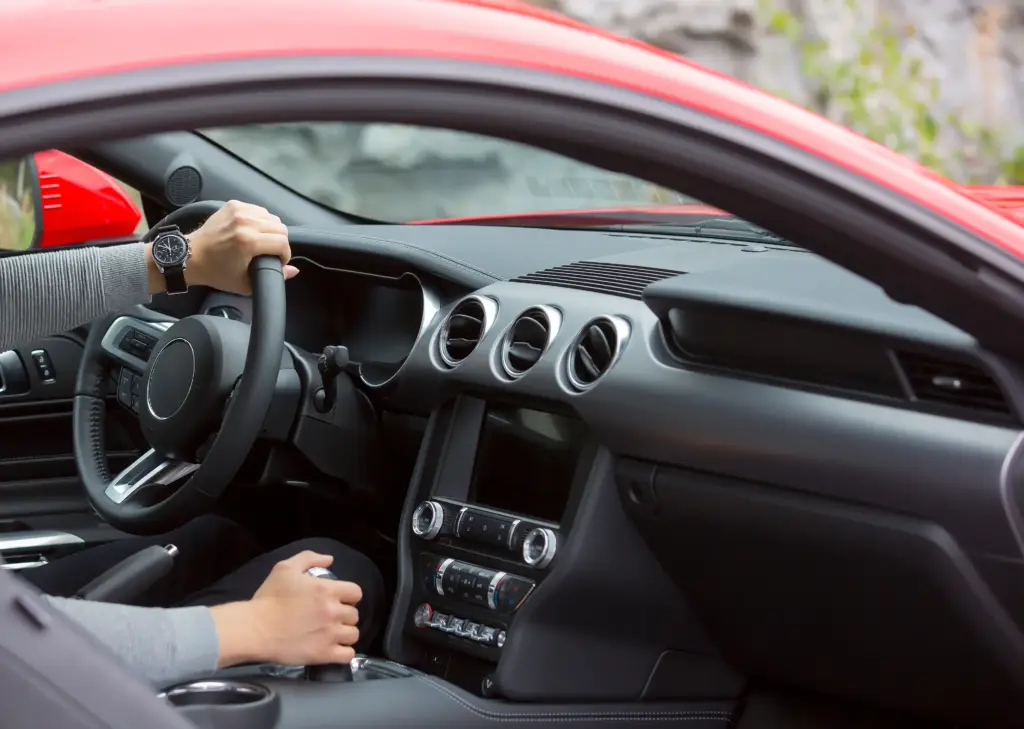
Steering rack and column. The steering assembly moves from the left side of the firewall to the right, which on a modern Mustang means relocating or replacing the steering assembly using engineered RHD components, the column, and their mounting points to match the chassis on the opposite side.
Pedal box and floor pan. The accelerator, brake, and clutch (on manual cars) move across, along with the floor pan brackets that hold them.
Dashboard and instrument cluster. The dash is redesigned or replaced so the gauge cluster sits in front of the new driving position, and the wiring harness behind it is re-routed to match.
Electronics and safety systems. This is the part that separates a careful conversion from a poorly executed one. Systems such as airbags, steering-angle sensors, instrument electronics, and certain driver-assistance features may require recalibration or reconfiguration after conversion.
Structural integrity. Every mounting point that changes side should maintain structural integrity through properly engineered mounting points and reinforcement. This is precision engineering work, not a cosmetic modification.
Where Is a Mustang RHD Conversion Performed?
Daytona sources Mustangs through a trusted dealer and supplier network, and conversion and compliance work is carried out through specialist partners in Sri Lanka, Dubai, and Australia before the car completes its journey to India. Keeping conversion with experienced specialist shops, rather than a general body shop, is what keeps the car’s structural integrity and electronics intact through the process.
When Does Right-Hand Drive Conversion Happen During the Import Process?
Conversion happens after sourcing and before the car reaches Indian customs and homologation. It is not a separate side project; it is one stage in the broader 16-to-24-week import process that covers sourcing, shipping, customs clearance, and RTO registration.
Once the car is on Indian soil, ARAI or ICAT still need to sign off through CMVR approval before an RTO will register it, regardless of the quality of the conversion work. A full-level approval typically takes around 45 working days; a partial-level approval, used where documentation or spec changes apply, runs closer to 30.
Common Mistakes Buyers Make
Assuming a “kit conversion” is good enough. A Mustang’s structural and electronic systems are not designed for a shortcut swap. Cutting corners can lead to as safety-system faults or structural weak points.
Not asking where the conversion happens. A conversion done by an experienced specialist partner is a very different outcome from one done by the lowest-cost workshop available.
Treating conversion and homologation as the same step. They are not. Conversion is the physical rebuild; homologation is the government certification that confirms it meets Indian standards. Both are required.
Skipping documentation. Proper records of the conversion process are needed for customs clearance and registration, not just for the buyer’s own peace of mind.
Final Thoughts
Right-hand drive conversion is the single piece of engineering that turns an imported Mustang GT into a vehicle that is legal and practical for Indian roads. Done properly, it preserves everything that makes the car worth importing in the first place. Done badly, it is the kind of shortcut that often costs far more to correct later than any money saved upfront.
Interested in the 2026 Ford Mustang GT?
Speak with the Daytona Exotics team to discuss specifications, import timelines, ownership costs, and whether the 2026 Ford Mustang GT is the right fit for your lifestyle.
Explore our website gallery and follow Daytona Exotics on Instagram, LinkedIn, and Facebook for curated additions, ownership insights, and market updates.
Explore our website gallery and follow Daytona Exotics on Instagram, LinkedIn, and Facebook for curated additions, ownership insights, and market updates.